


BATTERY INSTALLATION
BATTERY REQUIREMENT
ELECTRIC STARTER MODEL
Choose a 12 Volt cranking-type lead acid battery that meets the specifications shown below.
650 Marine Cranking Amps (MCA)/ABYC, or 512 Cold Cranking Amps (CCA)/SAE or 160 Reserve Capacity (RC) Minutes/SAE
• The specifications listed above are the minimum battery rating requirements for starting the engine.
• Additional electrical loads from the boat will require larger capacity batteries. Consult your Suzuki dealer to determine the proper battery sizing for your boat and engine combination.
• Dual-purpose (Cranking/Deep-cycle) batteries can be used if they meet the minimum specifications listed above (MCA, CCA, or RC).
• Do not use a Deep Cycle battery for the main cranking battery.
• The use of Maintenance-Free, sealed, or GelCell batteries is not recommended because they may not be compatible with Suzuki’s charging system.
• When connecting batteries in parallel, they must be of the same type, capacity, manufacturer, and of similar age. When replacement is necessary, they should be replaced as a set. Consult your Suzuki dealer for proper battery installation information.
BATTERY INSTALLATION
Secure the battery in a dry area of the boat, away from vibration.
• It is recommended that the battery be installed in an enclosed battery case.
• When connecting batteries, hexagon-nuts must be used to secure battery leads to battery posts.
To hook up the battery, first connect the red lead from the motor to the positive battery terminal, then connect the black lead to the negative battery terminal.
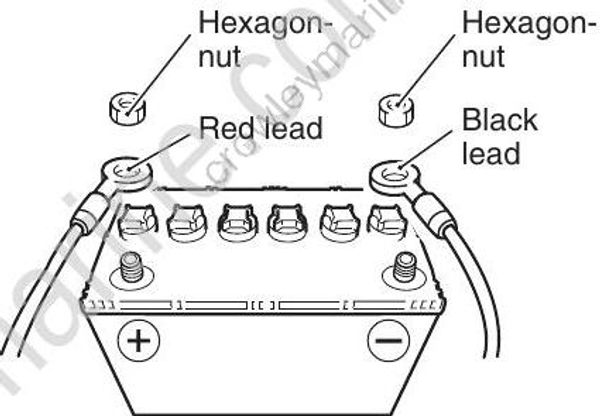
To remove the battery, first disconnect the black lead from the negative terminal, then disconnect the red lead from the positive terminal.
Suzuki recommends that you install the terminal cap on the positive battery terminal to prevent an accidental short circuit of battery terminals.
If a terminal cap is required, contact your authorized Suzuki marine dealer.
Connecting and disconnecting the battery as described above will help minimize the chance of creating an accidental short circuit and sparks.
If you place the battery near the fuel tank, a spark from the battery may ignite the gasoline, causing a fire and/or an explosion. Do not place the fuel tank in the same compartment/area as the battery.
Batteries produce flammable hydrogen gas and may explode if they are near flames or sparks. Never smoke or cause sparks when working near the battery. Keep the battery away from open flames. To avoid creating a spark when charging the battery, connect the battery charger cables to the proper terminals before turning the charger on.
Battery acid is poisonous and corrosive. It can cause severe injury and can damage painted surfaces. Avoid contact with eyes, skin, clothing, and painted surfaces. If battery acid comes in contact with any of these, flush immediately with large amounts of water. If acid contacts the eyes or skin, get immediate medical attention.
The electrical system or its components may be damaged if proper battery precautions are not followed.
• Be sure to attach battery leads correctly.
• Do not disconnect battery leads from the battery while the engine is running.
USE OF ELECTRICAL ACCESSORIES
To use electrical accessories, you must purchase a 70 AH or larger battery, rectifier and related items. (Recoil starter model only).
If you connect electrical accessories directly to the power receptacle of the motor, the electrical accessories could be damaged. Connect lights and electrical accessories for the boat to the battery. Consult your authorized Suzuki marine dealer for information about correct wiring.
The amount of power (12V DC) available for accessories depends on the operating condition of the motor. For getting a detailed information, please inquire of your authorized Suzuki Marine Dealer.
Use of too much power for electrical accessories under certain operating conditions can cause the battery to discharge.
On the models equipped with a charge connector, detach the charge cord from the connector and fit the cap to prevent water entry when not in use.