


INSPECTION AND MAINTENANCE
MAINTENANCE, REPLACEMANT OR REPAIR OF EMISSION CONTROL DEVICES AND SYSTEMS MAY BE PERFORMED BY ANY MARINE SI ENGINE REPAIR ESTABLISHMENT OR INDIVIDUAL USING ANY PART WHICH HAS BEEN CERTIFIED UNDER THE PROVISIONS IN THE CLEAN AIR ACT Sec. 207 (a) (2).
MAINTENANCE SCHEDULE
It is important to inspect and maintain your outboard motor regularly. Follow the chart below. At each interval, be sure to perform the indicated service. Maintenance intervals should be judged by number of hours or number of months, whichever comes first.
Never start the engine or let it run indoors or where there is little or no ventilation. Exhaust gas contains carbon monoxide, a gas that is colorless and odorless and can cause death or severe injury.
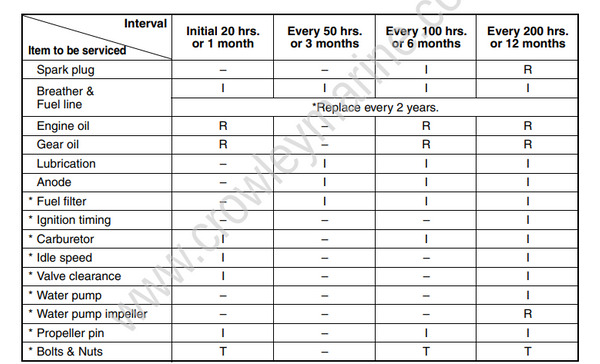
I: Inspect and clean, adjust, lubricate, or replace, if necessary T: Tighten R: Replace
Improper maintenance or failure to perform recommended maintenance can be hazardous. Poor maintenance increases the chance of an accident or equipment damage. Suzuki recommends that only your authorized Suzuki Marine Dealer or a qualified service mechanic perform maintenance on those items in the chart above which are marked with an asterisk (*).
You may perform maintenance on the unmarked items by referring to the instructions in this section if you have
mechanical experience. If you are not sure whether you can successfully complete any of the unmarked maintenance jobs, ask your authorized Suzuki Marine Dealer to do the maintenance for you.
• The safety of you and your passengers depends on how well you maintain your outboard motor. Follow all inspection and maintenance instructions carefully.
• Do not attempt to perform maintenance on this outboard motor if you do not have prior mechanical experience. You could be injured or may damage the motor.
• The maintenance intervals in the chart were established for normal usage of your outboard motor. If your outboard motor is used under severe conditions such as frequent full throttle operation or frequent operation in muddy, silty, sandy, acidic, or shallow water, you should perform maintenance more often than indicated in the chart. If you have any questions regarding appropriate maintenance intervals, consult your authorized Suzuki Marine Dealer.
• When replacing parts on your outboard motor, Suzuki strongly recommends that you use genuine Suzuki parts or their equivalent.
SPARK PLUG
Your outboard motor comes equipped with the following “standard” spark plug for normal usage.
| Standard spark plug | NGK CR6HSA |
It is important that you use ONLY a resistor type spark plug. Non-resistor types will interfere with the function of the electronic ignition, causing misfiring, or cause problems with other electronic boat equipment and accessories.
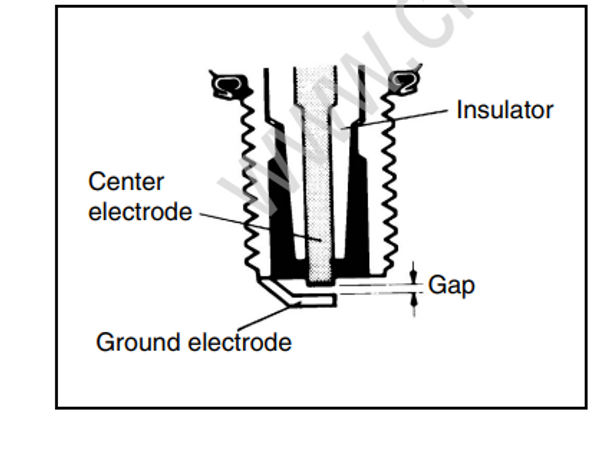
Your authorized Suzuki Marine Dealer can determine if the standard spark plug is suitable for your type of motor usage by inspecting the color of the plug’s porcelain center electrode insulator after operation.
If the plug tends to run hot (usually evidenced by whitening of the insulator or a burnt electrode), stop using your motor immediately as severe engine damage may result. If the plug tends to run cold (usually evidenced by blackening of the insulator or a wet electrode), performance may suffer. Ask your authorized Suzuki Marine dealer to evaluate either of these problems to determine the cause.
Use of improper spark plug can cause severe engine damage.
• Do not experiment with other spark plug brands unless you can determine that they are directly equivalent to the specified brand, or you may experience engine damage which will not be covered under warranty. Note that aftermarket cross-reference charts may not be accurate.
• To install the spark plug; seat it as far as possible by hand, then use a wrench to tighten it to either the recommended torque setting or rotation angle.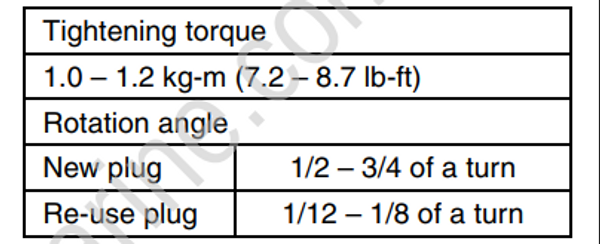
Do not overtighten or cross thread the spark plug, as this will damage the aluminum threads of the cylinder head.
• The spark plug must be seated properly and securely tightened. A loosely installed spark plug may get abnormally hot and engine damage could result.
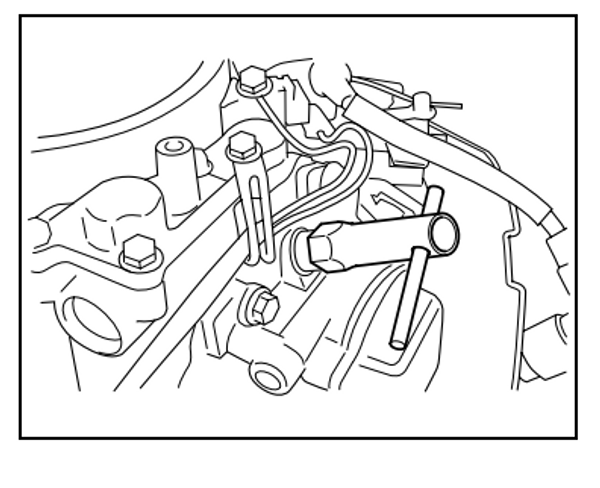
To maintain a strong spark, you should clean and adjust the plug at the interval shown in the maintenance schedule.
Remove carbon deposits from the spark plug using a small wire brush or spark plug cleaner, and adjust the gap as follows:
| Spark plug gap | 0.6 – 0.7 mm (0.024 – 0.028 in.) |
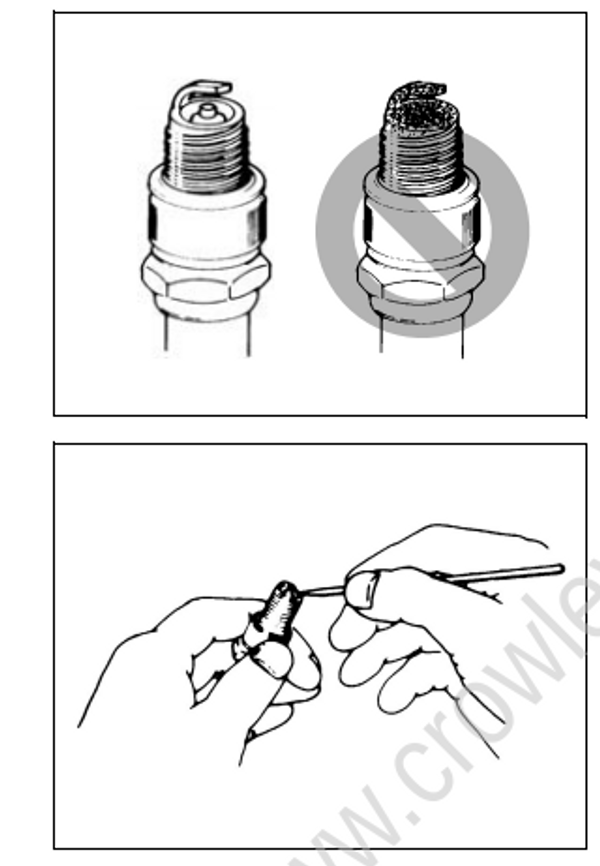
If the electrode or insulator is damaged, or if either shows excessive wear, then the spark plug should be replaced.
BREATHER AND FUEL LINE
Inspect the breather and fuel line for leaks, cracks, swelling, or other damage. If the breather and fuel line are damaged in any way, they must be replaced. Consult your authorized Suzuki Marine dealer if it is necessary to replace them.
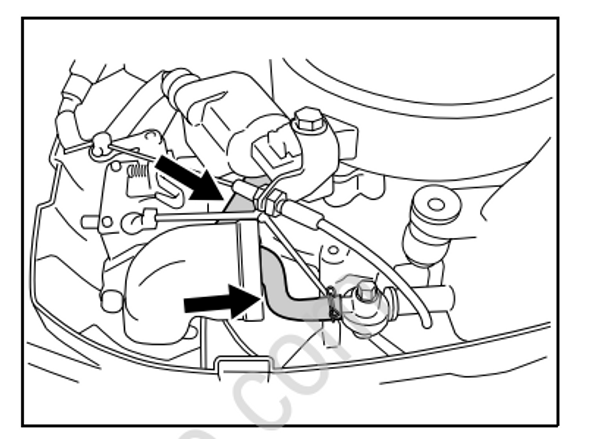
Fuel leakage can contribute to an explosion or fire, causing serious personal injury. Have your authorized Suzuki dealer replace the fuel line if there is any evidence of leaking, cracking or swelling.
ENGINE OIL
The motor must be shut off before any ENGINE OIL procedures are performed.
The oil should be changed more often when the engine is operated under adverse conditions like extended trolling.
Engine oil change
The oil should be changed when engine is warm so that the oil will drain thoroughly from the engine.
To change the engine oil:
Place the motor in a vertical position and remove the motor cover.
Remove the oil filler cap.
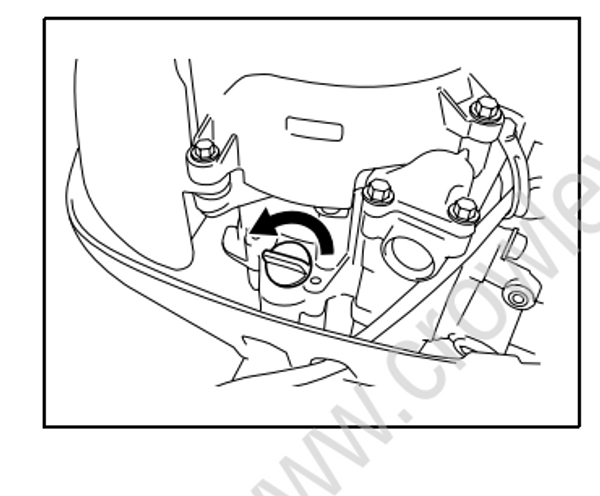
Place a drain pan under the engine oil drain plug.
Remove the engine oil drain plug and gasket, then let the engine oil drain.
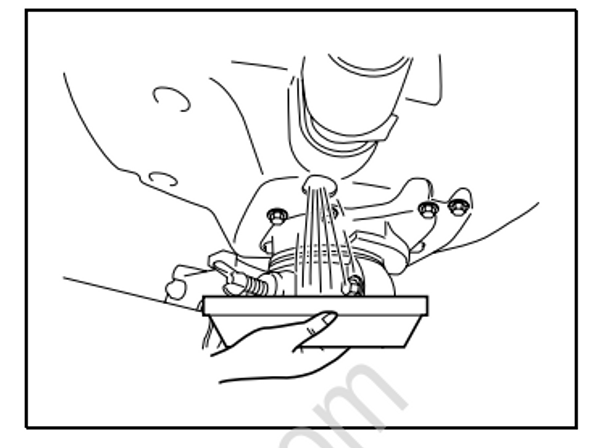
- After draining, secure the engine oil drain plug with a new gasket.
Do not re-use the removed gasket. Be sure to use a new gasket.
- Fill with recommended engine oil to the upper limit.
Oil capacity: 0.38 L (0.40/0.33 US/Imp. qt.)
Engine oil: SAE (or NMMA FC-W) 10W-40
API (or NMMA FC-W) Classification SG, SH, SJ, SL, SM
- Check the engine oil level. Refer to the INSPECTION BEFORE BOATING section.
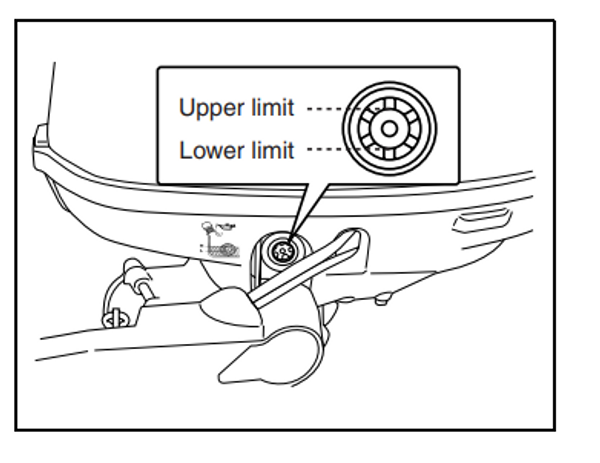
To avoid incorrect measurement of engine oil level, check oil level only when the engine has cooled.
- Reinstall the oil filler cap.
• The engine oil temperature may be high enough to burn your fingers when the drain plug is loosened. Wait until the drain plug is cool enough to touch with bare hands.
• New and used oil can be hazardous. Children and pets may be harmed by swallowing new or used oil. Continuous contact with used engine oil has been found to cause skin cancer in laboratory animals. Brief contact with used oil may irritate skin.
• Keep new and used oil away from children and pets. To minimize your exposure to oil, wear a long-sleeve shirt and moisture-proof gloves (such as dishwashing gloves) when changing oil. If oil contacts your skin, wash thoroughly with soap and water. Launder any clothing or rags if wet with oil.
Recycle or properly dispose of used engine oil. Do not throw it in the trash, pour it on the ground, down a drain, or into the water.
GEAR OIL
To check the gear oil level, place the motor in an upright position, remove the gear oil level plug and look into the hole. The oil level should be at the bottom edge of the hole. If the oil level is low, add the specified gear oil until the level reaches the bottom edge of the hole. Then, reinstall and tighten the plug.
Periodic gear oil replacement is essential for long life of your outboard motor.
To change the gear oil:
Make sure the motor is in an upright position. Place a drain pan under the lower casing.
Remove the gear oil drain plug (1), then remove the gear oil level plug (2).
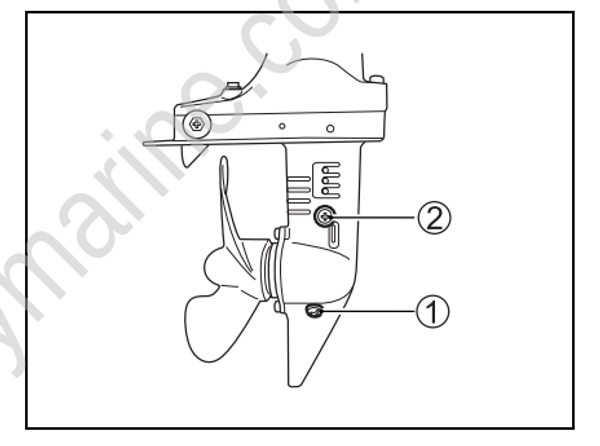
After the oil has drained completely, inject the specified gear oil into the lower drain hole until it just starts to come out of the upper level hole. Approximately 60 ml (2.0/ 2.1 US/lmp. oz.) will be required.
Reinstall and tighten the gear oil level plug (2), then quickly reinstall and tighten the gear oil drain plug (1).
To avoid insufficient injection of gear oil, check the gear oil level 10 minutes after doing the procedure in the step 4. If the oil level is low, slowly inject the gear oil up to the correct level.
New and used oil can be hazardous. Children and pets may be harmed by swallowing new or used oil. Continuous contact with used gear oil has been found to cause skin cancer in laboratory animals. Brief contact with used oil may irritate skin. To minimize your exposure to used oil, wear a long-sleeve shirt and moisture proof gloves (such as dishwashing gloves) when changing oil. If oil contacts your skin, wash thoroughly with soap and water. Launder any clothing or rags if wet with oil. Recycle or properly dispose of used oil.
If fishing line should wrap around the rotating propeller shaft, this may damage the propeller shaft oil seal allowing water to enter the gear case causing severe mechanical damage.
The seal will need to be replaced and the internal gear case components should be inspected for damage.
Gear oil contaminated with water will have a milky color. If you notice any water in the gear oil, immediately contact your authorized Suzuki Marine Dealer. Do not operate until the oil is changed and the reason for contamination is eliminated.
LUBRICATION
Proper lubrication is important for the safe, smooth operation and long life of each working part of your outboard motor. The following chart shows the lubrication points of your motor and the recommended lubricant:
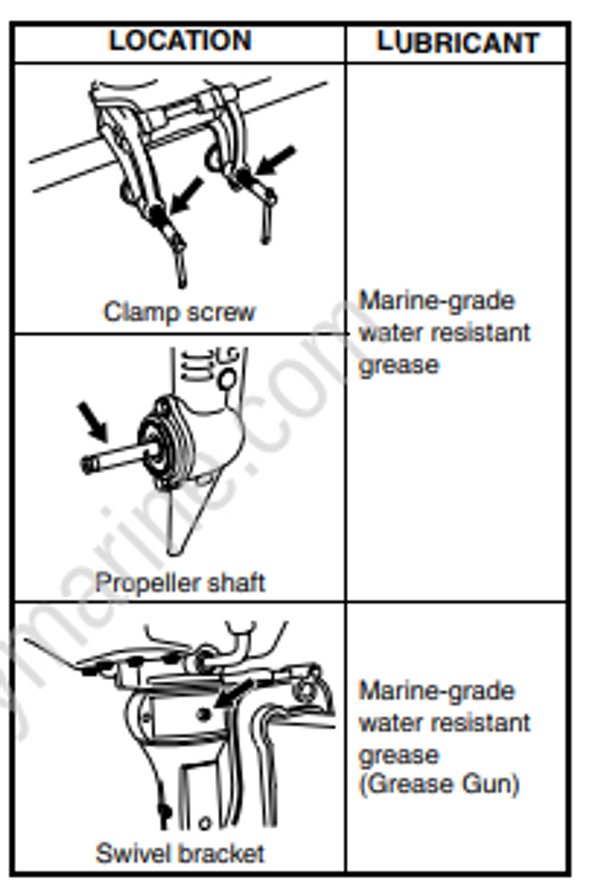
Your authorized Suzuki Marine Dealer may also have additional recommendations due to regional climate or operating conditions.
Please consult him for advice.
CORROSION PREVENTION
ANODE
The motor is protected from exterior corrosion by an anode. This anode controls electrolysis and help prevent corrosion. The anode will corrode in place of the parts they are protecting. You should periodically inspect the anode and replace it when 2/3 of the metal has corroded away.
In certain areas of the country, the water is unusually harsh on metal. Additional anti-corrosion measures may be helpful under those conditions. Consult your authorized Suzuki Marine Dealer for details.
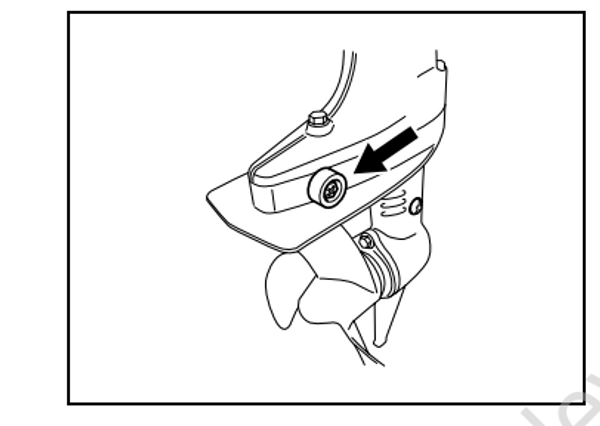
• If the anode has become detached or corroded away, underwater aluminum surfaces (such as the lower unit) will suffer galvanic corrosion damage.
• Do not paint the anode, as this will render it ineffective.
• The anode should be cleaned periodically with a wire brush to remove any coating which might decrease its protective ability.
FUEL FILTER
The fuel filter must be inspected by authorized Suzuki Marine Dealer periodically. Inspect fuel filter at every 50 hours (3 months).
FLUSHING THE WATER PASSAGES
ENGINE RUNNING – Vertical position –
Suzuki recommends that you flush the water passages by using this method.
• Never start the engine or let it run indoors or where there is little or no ventilation. Exhaust gas contains carbon monoxide, a gas that is colorless and odorless and can cause death or severe injury.
• Make sure the engine remains in NEUTRAL while flushing out the water passages. If shifted into gear, the propeller shaft will turn, possibly resulting in personal injury.
• Make sure the motor is properly clamped to a secure stand or boat and remain in attendance until flushing is
completed.
• Keep children and pets away from the area, and stay clear of all moving parts during this procedure.
Never start the motor without supplying water to the cooling system as water pump damage could result in as little as 15 seconds. Severe engine damage could result from no water supply.
After operation in muddy, brackish, or salt water, you should flush the water passages and motor surface with clean, fresh water. If you do not flush the water passages, salt can corrode the motor and shorten its life.